In Donelson, the Real Line Isn't Zip Code. It's 65 Decibels.
August 20, 2026
"There's only so much you can do. Move!" That's how one Donelson resident summed up his relationship with Nashville International Airport in a WKRN interview about the neighborhood's growing air traffic. It's the kind of line that gets repeated at cookouts and porch conversations across 37214, usually with a shrug attached. Most people who buy in Donelson already know the deal: you're minutes from BNA, the tradeoff is some airplane noise, the upside is a lot more house for the money than East Nashville or Green Hills.
What almost nobody checks before they write an offer is where, exactly, that tradeoff starts and stops. And that line matters more than the neighborhood's median price, because it's the thing actually setting values street by street.
Here's the part that gets flattened in most conversations about "the airport neighborhood." The FAA maintains a formal noise contour map for BNA, and according to an analysis of Greater Nashville REALTORS MLS data against that map, only about 15 percent of Donelson actually sits inside the 65-decibel contour, the threshold where noise measurably affects value. Homes inside that line carry roughly a 5 to 8 percent price discount compared to similar homes outside it. The other 85 percent of the neighborhood shows no measurable noise penalty at all, and instead picks up a quiet tailwind from BNA's own footprint: the airport supports roughly 14,200 direct jobs, many of them filled by people who chose to live close by.
That's a very different story than "Donelson is cheaper because it's loud." Most of Donelson isn't in the discount zone. A specific, mappable minority of streets are, and that's where the neighborhood's reputation for being an affordable trade quietly gets baked into actual sale prices, block by block, rather than applied evenly across the zip code.
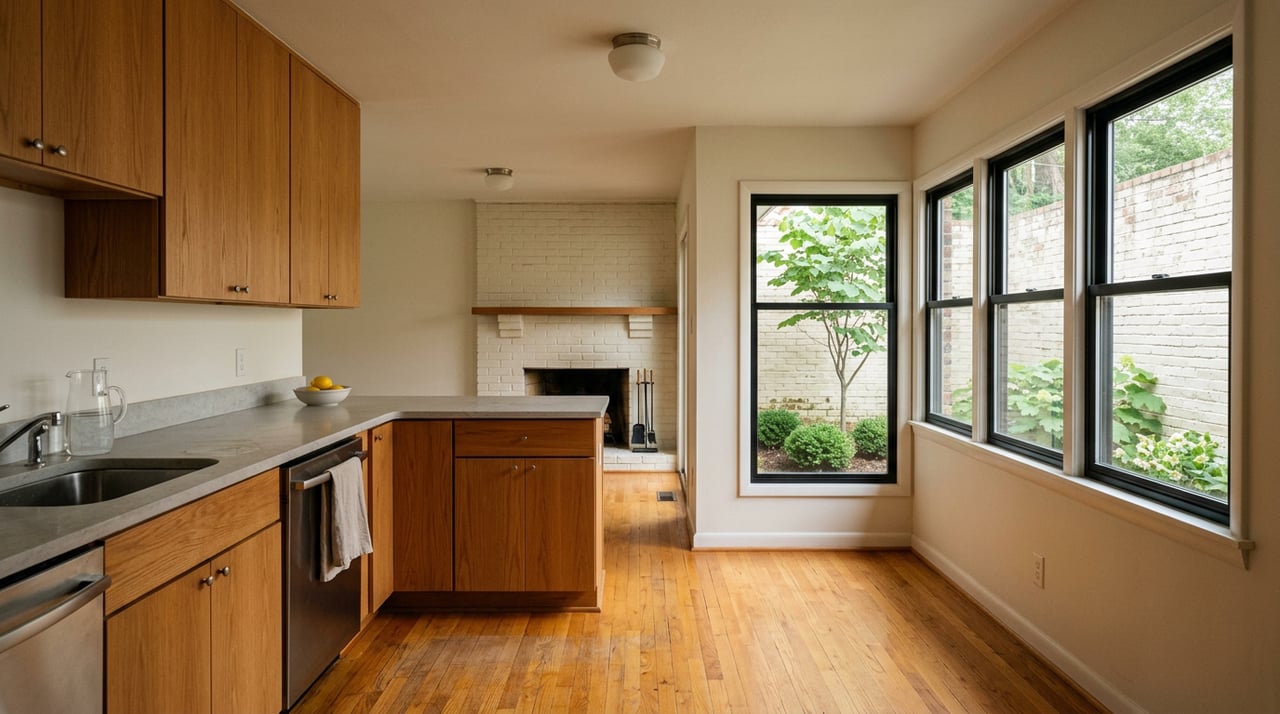
You can see the shadow of this in how differently Donelson's own sub-neighborhoods price out. Bluefields, the 1950s brick-ranch pocket where tree-lined streets and larger lots draw buyers who care about bones, runs meaningfully above the neighborhood's overall median. Merry Oaks, Woodberry Park, and Eva Mor Heights sit well below it. Some of that gap is lot size and renovation level. But it's also true that multiple sources describing Bluefields note that some pockets within it experience more direct overhead traffic than others, meaning even a single beloved subdivision isn't priced as one thing. It's priced as whichever side of the line a given street happens to fall on.
Here's where this stops being a quirky fact and starts being a real underwriting question. The noise contour isn't a fixed boundary drawn once and left alone. It moves as air traffic grows, and BNA's traffic has been growing faster than anyone planned for.
When the Metropolitan Nashville Airport Authority launched its first expansion program, BNA Vision, back in 2016, it built the plan around the FAA's most aggressive passenger forecast at the time: 30 million annual travelers by 2029. Nashville simply outgrew that number. A refreshed analysis now points to BNA handling as many as 40 million passengers a year by 2037, and the airport authority has already moved on to a second program, called New Horizon, a $3 billion buildout layered on top of the $1.5 billion BNA Vision program completed in February 2024. Combined, that's $4.5 billion in airport investment since 2017.
More flights don't necessarily mean louder individual planes. As one Metro Councilmember representing Donelson's district put it in that same WKRN piece, the planes aren't getting louder, there are just more of them. But more of them is exactly what redraws a noise contour. BNA's own 2025 forecast showed noise levels in the 65 to 75 decibel range creeping into neighborhoods just north of Interstate 40, an area that wasn't previously part of the affected zone.
That's the mechanism a median price will never show you. A street that sits safely outside today's discount zone isn't guaranteed to stay there for the life of a 30-year mortgage. And the appraisal or comp sheet a buyer sees at closing reflects the contour as it existed when that data was pulled, not necessarily the one that will exist five years into ownership.
None of this makes Donelson a neighborhood to avoid. It makes it a neighborhood where the growth story and the discount story are the same story, just viewed from opposite sides.
The infrastructure spending tied to BNA's expansion is landing directly in Donelson's backyard, not as an abstraction but as finished road projects. TDOT completed the Donelson Pike relocation and its new Diverging Diamond Interchange in June 2025, after more than a decade of coordination, freeing up airport-adjacent land for further terminal roadway work. The airport's Central Core Enhancement Project, an 18-month overhaul of the terminal's escalators and elevators, is underway now and expected to wrap by December 2027. The Concourse D Extension, the first completed New Horizon project, already opened. Every one of these is a sign that the jobs and accessibility drawing people to Donelson in the first place aren't slowing down.
So the honest read on Donelson right now isn't "avoid the noisy streets, buy the quiet ones." It's that both categories are being shaped by the same expansion, and a buyer who understands which category a specific address falls into, and how that category might shift, is working with better information than one comparing neighborhood averages on a portal.
A few things follow from all of this, and they're more useful than a generic noise disclaimer:
Does every home in Donelson sit inside the noise-affected zone? No. Based on the FAA contour analysis against MLS data, roughly 15 percent of the neighborhood falls inside the 65-decibel line where the price discount shows up. The large majority of Donelson carries no measurable noise penalty and instead benefits from BNA's job base and infrastructure investment.
Is the noise line going to keep expanding? BNA's own forecasting has already shifted once, from a 30 million passenger plan to a 40 million passenger target by 2037, and a 2025 noise forecast showed levels expanding into areas just north of I-40. Nothing in the public record suggests that trajectory is reversing, which is exactly why a current contour map matters more than a general reputation for "some airport noise."
If you're comparing Donelson against other pockets of Nashville, or trying to figure out which specific streets are worth a closer look, that's the kind of block-level read that doesn't show up on a listing page. Dawn Cassara works this market street by street, and can pull the current noise contour and comp data for any address you're considering before you ever make an offer.
Stay up to date on the latest real estate trends.

Dawn Cassara is dedicated to delivering exceptional real estate experiences with a personalized approach. Her expertise and commitment ensure clients achieve their goals seamlessly.